Best Trailer Hitch Options for Your Car: Tow Safely and Expand Capabilities
Choosing the right trailer hitch for your car involves matching your vehicle’s frame and towing needs with a hitch class, receiver size, and weight rating. This guide reviews five well-regarded hitches and related accessories to help you decide which setup best fits light to moderate trailers, bike racks, or storage trailers. Each product features a clear compatibility profile, installation notes, and practical towing considerations for common American vehicles.
Summary of Selected Products
| Product | Class / Receiver | Recommended Use | Approx. Weight Capacity |
|---|---|---|---|
| Gelacie Class 1 Rear Trailer Hitch | Class 1, 1.25″ Receiver | Small trailers, bike racks, light-duty towing | 2000 lbs gross trailer weight / 200 lbs tongue weight |
| CURT 13146 Class 3 Trailer Hitch | Class 3, 2″ Receiver | Mid-size SUVs and crossovers, versatile towing | 6,000 lbs gross trailer weight |
| Draw-Tite 76320 Class 4 Trailer Hitch | Class 4, 2″ Receiver | Higher-capacity towing for larger trailers | Not stated here, built for heavier loads |
| CURT 13068 Class 3 Trailer Hitch | Class 3, 2″ Receiver | Honda Odyssey and family vans, versatile towing | 3,500 lbs gross trailer weight |
| Nilight Bolt-On Receiver Tube Adapter | 2″ opening adapter | Universal compatibility with various hitches | Adapter accessories; not a hitch itself |
Gelacie Class 1 Rear Trailer Hitch

This Class 1 hitch is designed for smaller vehicles and lighter towing tasks. It uses a 1.25″ receiver and supports up to 2,000 lbs gross trailer weight with about 200 lbs tongue weight, making it suitable for bicycle racks, small cargo trailers, and similar light-duty attachments. It acknowledges compatibility with 2007–2013 Nissan Altima, 2014–2021 Altima, and 2009–2021 Maxima models (drilling may be required for some installations). The hitch is described as highly versatile and easy to add to compatible cars, expanding carrying capacity for everyday travel and outdoor activities. As with all Class 1 hitches, installation should follow the manufacturer’s guidelines to ensure safe towing conditions.
CURT 13146 Class 3 Trailer Hitch

This CURT Class 3 hitch provides a robust 2-inch receiver for versatile mid- to full-size vehicle towing. It is rated for a gross trailer weight of up to 6,000 lbs and a tongue weight around 900 lbs, depending on vehicle compatibility and trailing components. CURT emphasizes real-world, on-vehicle testing and SAE J684 standards to ensure safety and reliability. This hitch is suitable for a wide range of SUVs and crossovers that need a dependable ballast for campers, small trailers, or larger bike racks. Proper installation and adherence to weight limits are essential for optimal performance.
Draw-Tite 76320 Class 4 Trailer Hitch

The Draw-Tite Class 4 hitch offers a 2-inch receiver and is built from solid welded steel. It is designed for high-strength towing with rugged fatigue testing and is protected by a durable two-part black powder coat to resist rust and corrosion. Compliance with V-5 and SAE J684 standards is highlighted, underscoring its safety credentials for heavier trailers and more demanding towing tasks. It is well-suited for SUVs and larger vehicles that require substantial towing capacity without compromising ride quality.
CURT 13068 Class 3 Trailer Hitch

CURT’s 13068 Class 3 hitch is a 2-inch receiver solution designed for Honda Odyssey models and similar vans. It is rated for up to 3,500 lbs gross trailer weight and 350 lbs tongue weight, aligning with many family-vehicle towing scenarios. Like CURT’s other products, this hitch emphasizes real-world testing and SAE J684 compliance, ensuring dependable performance for caravans, bike racks, or light campers while maintaining compatibility with standard 2″ hitch equipment.
VONLX Golf Cart Trailer Hitch

The VONLX 2″ receiver golf cart hitch extends trailer capabilities for golf carts from popular brands like Club Car, EZGO, and Yamaha. It adds rear-seat hitch functionality, enabling towing of accessories and light loads. The design emphasizes adjustable mounting distances (10 5/8 to 11 inches) to accommodate various golf-cart models, with a heavy-duty steel build and black powder coating for rust resistance. This product targets niche towing needs where a standard automotive hitch is not suitable, expanding outdoor utility for golf enthusiasts or facility maintenance fleets.
DEEAGLE Hitch Tightener Anti-Rattle

The DEEAGLE hitch tightener reduces movement and rattling in 1.25″ to 2″ hitch systems, improving ride quality and protecting both hitch components and towed loads. It features a 0.28″ powder-coated plate and rubber-coated U-bolts for resilience against weather and road conditions. The universal fit supports Class I–IV hitches, making it adaptable for a wide range of towing setups, including cargo carriers, bike racks, or light trailers. Proper installation helps extend the life of towing equipment and maintain a quieter, smoother tow.
MAXXHAUL 50025 Hitch Mount 2 Bike Rack
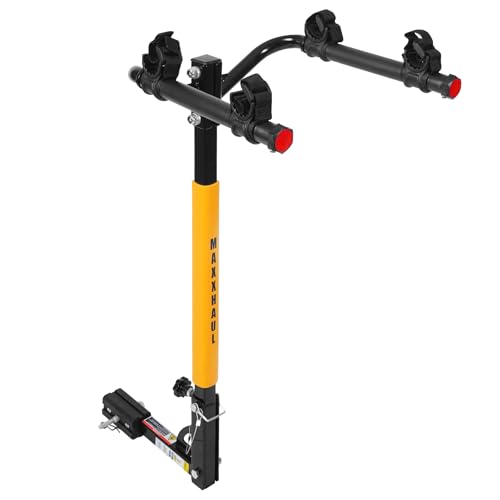
The MAXXHAUL 50025 bike rack attaches to a standard hitch receiver to transport up to two bikes securely. It supports a range of hitch receivers, including 1-1/4″ and 2″, and uses rubber cradles and buckle-type straps to stabilize bicycles during transit. While not a hitch itself, it complements a capable hitch setup by enabling safe, practical bike transportation for family trips and outdoor adventures.
Buying Guide: How To Choose The Right Trailer Hitch And Accessories
Key factors influence the right hitch choice for most American drivers. Start by matching the receiver size to your towing needs and the vehicle’s payload rating. Class 1 hitches with 1.25″ receivers are ideal for light trailers and bike racks on compact cars. Class 3 and Class 4 hitches with 2″ receivers support larger trailers, campers, and utility carriages, but require careful alignment with vehicle capacity and factory towing provisions.
When evaluating hitches, pay attention to weight ratings. Gross trailer weight (GTW) indicates how much trailer the hitch can safely pull; tongue weight (TW) informs how much downward force on the hitch is acceptable. Always verify these figures against the vehicle’s towing capacity and the trailer’s weight. SAE J684 and V-5 testing standards demonstrate durability and safety in real-world conditions, which is a reasonable expectation for any aftermarket hitch.
Consider installation complexity. Some hitches require drilling or vehicle modification, especially for certain car models or higher-capacity options. Others are “bolt-on” replacements that reuse existing mounting points, which generally simplifies installation but may demand professional assistance for best alignment. In addition to the hitch, accessories like anti-rattle devices, adapters, and bike racks expand functionality but may influence weight and stability. Always use manufacturer-recommended hardware and torque specifications for secure mounting and safe towing.
Compatibility is essential. Not every hitch fits every vehicle, even within the same class. SUVs, vans, and crossovers often have different mounting points, exhaust clearance, and electrical harness considerations. If you plan to tow trailers with distinctive frames or require bike mounting systems, ensure that the chosen hitch or accessory supports your exact configuration and complies with any local towing regulations.
Durability and finish matter. A powder-coated finish resists corrosion and extends life in harsh weather. Welded steel hitches tend to deliver greater strength, especially in Class 3 and Class 4 configurations. For high-usage scenarios or frequent towing, investing in a proven brand with robust testing protocols may reduce maintenance and replacement costs over time.
Price often reflects capacity and build quality, but it is not the sole predictor of value. Compare installation time, warranty coverage, and the availability of compatible parts (for example, wiring harnesses and mounting kits). A well-chosen hitch that meets your needs, installed correctly, will provide safer towing and improve overall vehicle versatility for daily driving and weekend towing alike.