Best Portable Car Diagnostic Scanners for Quick Vehicle Troubleshooting
Finding a portable car diagnostic scanner that works across many vehicles and delivers clear results can save time and money. This guide highlights five top picks, covering budget-friendly options and professional-grade tools. Each scanner reads and clears engine codes, provides live data, and helps you understand emissions readiness. Use this overview to compare features, compatibility, and ease of use to pick the right tool for your garage.
| Product | Brand | Key Benefit | Protocol Coverage |
|---|---|---|---|
| ANCEL AD310 Classic | ANCEL | Compact, sturdy OBD II scanner with fast code reading | OBDII |
| BlueDriver Bluetooth Pro | BlueDriver | Professional-grade diagnostics with repair reports | OBDII, 1996+ |
| VDIAGTOOL VD10 | VDIAGTOOL | Affordable code reader with freeze frame and I/M readiness | OBDII |
| MOTOPOWER MP69033 | MOTOPOWER | Wide vehicle support with real-time data and display | OBDII |
| FOXWELL NT301 | FOXWELL | Live data, VIN retrieval, easy plug-and-play | OBDII |
ANCEL AD310 Classic Enhanced OBD II Scanner

The ANCEL AD310 is a best-selling OBD II scanner known for its reliability and clear results. It reads and clears diagnostic trouble codes, shows live data, freeze frames, and I/M readiness information. The device is compact, weighing about 12 ounces, with a 2.5-foot cable for flexible use in tight engine bays. It powers directly from the vehicle’s OBD II port, eliminating the need for batteries. Its straightforward interface helps users quickly identify check engine issues and confirm repairs have resolved them.
BlueDriver Bluetooth Pro OBDII Scan Tool

BlueDriver is designed for a professional-grade diagnostic experience via a smartphone app. It reads and clears codes, including ABS, Airbag, SRS, and TPMS, and provides repair reports with possible causes and fixes. Real-time health monitoring delivers live data as you drive, helping you identify issues early. The app-based approach makes it easy to share results with shops or family members and to track repairs over time without separate hardware.
VDIAGTOOL VD10 OBD2 Scanner
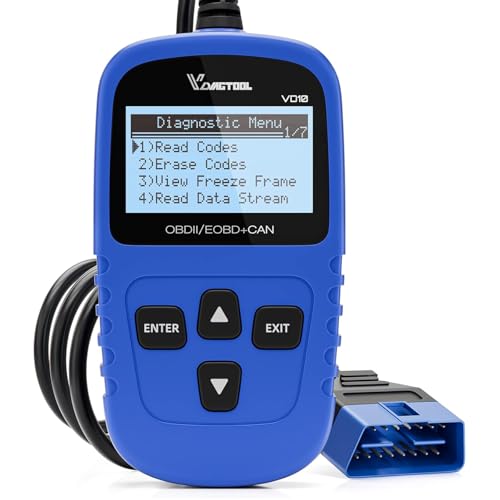
VDIAGTOOL’s VD10 is a versatile, user-friendly diagnostic tool for DIY enthusiasts. It reads and clears codes, displays live data and freeze frames, and shows I/M readiness and vehicle information. With a built-in database covering more than 3,000 codes, it helps users quickly interpret fault codes and identify root causes. It’s designed to be easy to use right out of the box and works across most OBDII-compliant vehicles.
MOTOPOWER MP69033 Car OBD2 Scanner

The MOTOPOWER MP69033 combines broad protocol support with an easy-to-read 2.8-inch LCD display. It reads and erases codes, shows live data, and displays vehicle information. It supports multiple languages and supplies power directly from the vehicle, so no extra battery or charger is needed. This scanner is a practical choice for homeowners and hobbyists who want a dependable, all-around diagnostic tool for a wide range of OBDII vehicles.
FOXWELL NT301 OBD2 Scanner

The FOXWELL NT301 focuses on essential CEL reading and clearing, with easy plug-and-play operation. It retrieves the vehicle’s VIN and supports live data streaming for quick diagnostics. Suitable for DIYers and professionals alike, the NT301 provides clear results and reliable performance across most 1996+ gasoline cars, light trucks, and SUVs in the U.S., Europe, and parts of Asia.
Buying Guide: Key Purchase Considerations
- Vehicle compatibility: Ensure the scanner supports your vehicle’s year, make, and model, and check for the presence of CAN/OBDII protocols if needed for newer vehicles.
- Code reading and clearing: Look for devices that read generic and manufacturer-specific codes, offer live data, freeze frame, and I/M readiness status to diagnose emissions problems.
- Data presentation: Decide between handheld devices and app-connected tools. If you prefer mobile use, consider Bluetooth/Wi-Fi models with intuitive dashboards and export options for repair records.
- Ease of use: For beginners, plug-and-play options with clear menus and VIN retrieval are valuable. For professionals, consider features like repair reports and broader code libraries.
- Power and display: Ensure power sourcing from the vehicle’s OBDII port, and choose a readable display. A durable build and comfortable cable length improve usability in tight spaces.
- Language and support: Check for multilingual menus and accessible customer support, especially for non-English-speaking users or complex code interpretations.
- Budget vs. features: Balance price against features like live data graphs, advanced code descriptions, and the breadth of supported protocols to find the best value.
- Security and data privacy: If the device uses cloud storage or mobile apps, review data privacy practices and ensure you’re comfortable with data handling and sharing.
- Future-proofing: Some tools receive firmware updates or app enhancements; consider units with ongoing software support for long-term relevance.
- Repair workflow integration: For frequent repairs, tools offering comprehensive repair guidance, dealer-level diagnostics, or integration with professional software can add value.