Best Golf Cart Tire Pressure Gauge Buying Guide for Smooth Rides
Maintaining correct tire pressure on a golf cart is essential for optimal handling, fuel efficiency, and tire longevity. A reliable tire pressure gauge helps golf cart owners quickly verify pressure, especially when loading for a round or transporting equipment. This guide highlights five top-rated gauges, explains what to look for, and compares their strengths to help you choose the right tool for your cart, weather, and driving conditions.
Summary of selected products:
- ETENWOLF T300 Digital Tire Pressure Gauge 3-200 PSI (ANSI B40.7 Grade 2A, ±0.5%), Backlit LED
- ETENWOLF Tire Pressure Gauge for Cars 0-75 PSI (ANSI B40.1 Grade A, ±1%), Large Glow Dial
- WYNNsky Low Pressure Pencil Tire Gauge 1-20 PSI, for Golf Carts
- JACO ElitePro-X Tire Pressure Gauge with Lightning Chuck, 0-100 PSI
- ETENWOLF T300 Digital Tire Pressure Gauge 3-200 PSI, Grey variant (ANSI B40.7 Grade 2A, ±0.5%), Backlit LED
ETENWOLF Tire Pressure Gauge for Cars 0-75 PSI

This manual gauge covers a wide range from 0 to 75 PSI, suitable for most golf cart tires and small vehicles. It carries ANSI B40.1 Grade A accuracy, rated at plus-minus 1% of the span, which ensures dependable readings. The large glow dial improves readability in low-light conditions, such as early morning rounds or late evenings on the course. Its rugged build helps withstand frequent use on and off the cart. For golfers who prioritize straightforward operation and visibility, this gauge offers a solid balance of accuracy and ease of use.
Key features include: precise 0-75 PSI range, manual calibration, glow-in-the-dark dial, and a durable construction designed to withstand frequent handling. While it shines in standard tire checks, it does not include a digital readout or automatic data logging. This makes it ideal for players who want a reliable, quick measurement without battery dependence.
WYNNsky Low Pressure Pencil Gauge for Golf Carts

The WYNNsky pencil gauge specializes in low-pressure readings, making it especially useful for golf carts with soft suspensions or heavier loads that can cause underinflation. It offers calibration in 1/2-psi increments within a 1-20 PSI range, which provides fine granularity for precise adjustments. The device uses a chrome-plated zinc head with an aluminum body for sturdiness and long life on golf courses, in clubhouses, or in maintenance sheds. This gauge is compact, portable, and designed for quick checks during carts’ pre-round setups or post-transport inspections.
Pros include its precise low-pressure focus, durable materials, and compact footprint. Limitations include a narrower pressure range, so it may not cover higher pressures needed for some larger or heavier carts or aftermarket tires. Still, for golf carts commonly running in the 12-20 PSI zone, this tool offers reliable, repeatable readings with minimal effort.
JACO ElitePro-X Tire Pressure Gauge with Lightning Chuck
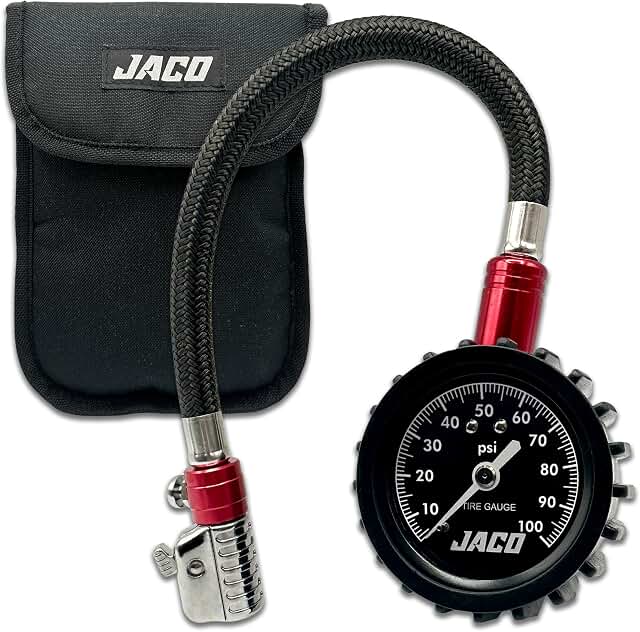
The JACO ElitePro-X delivers high accuracy up to 100 PSI with ANSI B40.1 compliance at ±1.5% accuracy, ensuring dependable tire readings for golf carts that use higher pressure tires or have newer configurations. Its standout feature is the Lightning Chuck, a patent-pending push-to-lock nozzle that instantly grips the valve stem, forming an airtight seal with minimal effort. The quick-release feature minimizes air loss when removing the gauge. This setup allows for fast, repeatable checks, crucial for golf course maintenance or busy clubhouses where multiple carts must be serviced quickly.
This gauge balances precision with user-friendly operation. While it does not require batteries, it relies on mechanical readings, which can be advantageous in environments where battery reliability is a concern. The gauge is well-suited for technicians and serious enthusiasts who value robust build quality and repeatable measurements across carts with varied tire types.
ETENWOLF T300 Digital Tire Pressure Gauge 3-200 PSI, Grey

This digital gauge covers a broad 3-200 PSI range with advanced ANSI B40.7 Grade 2A calibration and a Plus-Minus 0.5% accuracy, making it highly precise for golf carts with higher-performance tires or those operated in variable conditions. A built-in AI chip with thermal compensation ensures stable readings in extreme temperatures (-4°F to 130°F). The backlit LED display allows easy visibility in dim lighting, and the device is designed to maintain accuracy even as temperatures fluctuate on the course. This model is ideal for players and maintenance crews who need consistent, digital readouts and resilience in diverse weather.
Considerations for this digital model include battery replacement (AAA) and ensuring compatibility with presta valves if used on bicycles. Its high precision makes it a preferred choice for club fleets or enthusiasts who want data-driven maintenance and the ability to log readings over time for tire management programs.
Buying Guide: What to Look For in a Golf Cart Tire Pressure Gauge
- Pressure range: Match the gauge’s range to your cart’s tires. Standard golf cart tires often stay around 12-40 PSI, but some setups may require higher readings. Choose a gauge that covers your typical range with some headroom.
- Accuracy and calibration: Look for ANSI/B40.x or equivalent standards. A lower plus-minus percentage means more precise readings, which is valuable for maintaining even wear and optimal handling.
- Display type: Digital gauges provide exact numbers and potential data logging, while analog or pencil gauges are battery-free and quick to read by eye. For low-light use, a backlit display is helpful.
- Ease of use: Features like a locking chuck or quick-release valve connection reduce air loss and make checks faster during rounds or maintenance windows.
- Durability: Consider materials (metal or high-grade plastic), build quality, and protective cases if stored in a cart compartment or bag.
- Valves and adapters: Some gauges include adapters for different valve types; others may require separate purchases for bike valves if used in dual roles.
- Portability: Golf bags or maintenance carts benefit from compact, light gauges that fit in a pocket or tool pouch.
- Battery dependence: Digital gauges require batteries; ensure spare batteries are available and easy to replace during trips to the course.
From a performance perspective, the choice often boils down to whether you prioritize digital precision and readouts (better for data tracking and extreme conditions) or a simple, reliable mechanical gauge (less maintenance on the go). For fleets or frequently serviced carts, pairing a high-precision digital gauge with a reliable, quick-lock model can cover a wide range of scenarios on and off the fairway.