Best Fault Code Reader for Cars: Top OBD2 Scanners for Quick Diagnostics
Discover top fault code readers that help diagnose car issues, read and clear engine codes, and monitor live data. This guide highlights 5 reliable OBD2 scanners suitable for DIYers and professionals, with clear definitions and practical usage tips.
Summary of Selected Products
| Product | Brand | Key Benefit |
|---|---|---|
| ANCEL AD310 Classic Enhanced Universal OBD II Scanner | ANCEL | Fast reads, clears codes; compact and sturdy design |
| VDIAGTOOL VD10 OBD2 Scanner | VDIAGTOOL | Wide compatibility; strong DTC lookup |
| MOTOPOWER MP69033 Car OBD2 Scanner | MOTOPOWER | Comprehensive data, multiple protocols |
| ANCEL AD410 Enhanced OBD2 Scanner | ANCEL | Enhanced diagnostics, broad compatibility |
| FOXWELL NT201 OBD2 Scanner | FOXWELL | Easy I/M readiness and live data |
Product 1: ANCEL AD310 Classic Enhanced Universal OBD II Scanner

The ANCEL AD310 is a compact, reliable OBD II scanner designed to quickly identify the cause of the check engine light. It supports reading and clearing diagnostic trouble codes for emission systems, and it can display live data, freeze-frame information, I/M readiness, and vehicle details. It is powered directly from the vehicle’s OBDII port, with a sturdy build and clearly labeled buttons for easy operation in a workshop or driveway setting. This model is widely recommended for its speed and straightforward results, making it a practical option for routine maintenance and quick troubleshooting.
Key features include: read and clear engine codes, view live data and freeze frame, access memory data, monitor readiness, and gather vehicle data. The AD310’s 2.5-foot cable offers flexibility in tighter engine bays, and its compact weight makes transport simple for DIYers and professionals alike.
Product 2: VDIAGTOOL VD10 OBD2 Scanner
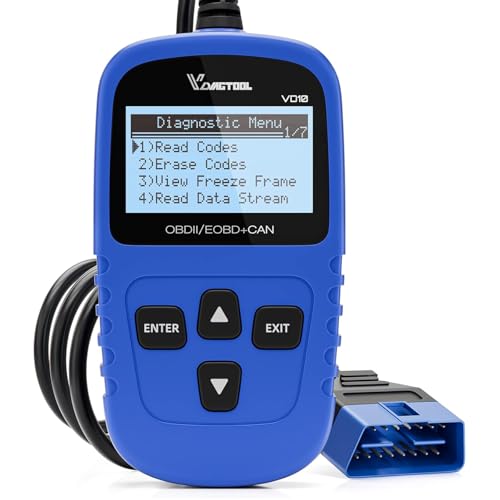
The VDIAGTOOL VD10 is a user-friendly diagnostic tool ideal for DIYers and hobbyists. Plug-and-play operation allows quick access to read and clear codes, view live data, and check I/M readiness. It retrieves both generic and manufacturer-specific codes, supports a broad range of OBDII protocols, and presents DTC definitions on-screen, helping you troubleshoot without needing online lookups. The device emphasizes speed and clarity, delivering straightforward insights for routine maintenance and problem isolation.
Key capabilities include: quick fault code retrieval, code clearing, freeze-frame data, I/M readiness, and a built-in code database with more than 3,000 codes. Its simplicity and rapid diagnostics make it a practical tool for at-home car care and on-the-road troubleshooting.
Product 3: MOTOPOWER MP69033 Car OBD2 Scanner

The MOTOPOWER MP69033 offers a robust feature set for all OBD II protocol cars since 1996. It supports multiple data points, including real-time data and freeze frame, and provides an engine fault code reading and erasing capability. The device emphasizes a wide protocol range and multilingual support, making it suitable for international users. Its 2.8-inch LCD with a clear display ensures easy interpretation of results, and it draws power directly from the vehicle via the OBDII port, requiring no separate battery.
Highlights include: broad protocol compatibility, live data streaming, data flow and vehicle information, and a readable display. It’s designed to empower users to diagnose engine issues quickly and proceed with informed repairs or professional consultations.
Product 4: ANCEL AD410 Enhanced OBD2 Scanner

The ANCEL AD410 is an enhanced OBD2 scanner designed for broader diagnostic capabilities across OBDII vehicles from 1996 onward. It supports quick reading and clearing of fault codes, MIL reset, and readiness checks, with extensive DTC lookups to help identify faults without external searches. The AD410 is marketed as a robust engine-focused tool with capabilities such as O2 sensor and EVAP testing to refine fuel efficiency and emissions diagnostics. This model emphasizes practical diagnostics and a more comprehensive scan compared with basic readers.
Key aspects include: wide OBDII compatibility, emissions-focused tests, rapid fault code resolution, and extensive DTC support. It clearly states that it focuses on engine diagnostics and does not claim to diagnose ABS or SRS in other iterations, which is important for buyers seeking engine-centric insight.
Product 5: UJS SAFESCAN OBD2 Scanner

The UJS 2026 Enhanced Universal OBD2 Scanner focuses on delivering a thorough health check using more than 45,000 built-in DTC lookups. It emphasizes a fast diagnostic cycle with an advanced I/M Readiness function and a plug-and-play setup that requires no battery. The guide highlights an emphasis on speed and clarity, allowing users to quickly determine whether the vehicle’s emission systems are ready for inspection, and to obtain a full health scan within about a minute.
Important features include: extensive DTC library, I/M readiness indicators, battery voltage check, and a straightforward plug-and-play workflow. This tool targets users who want a quick, reliable overview of vehicle health and emissions readiness without complex configuration.
Buying Guide: Key Purchase Considerations
When selecting a fault code reader for cars, consider scope, ease of use, and depth of diagnostic data. For casual DIYers, models like the AD310 or VD10 provide essential code reading and clearing with clear DTC definitions. If you need broader diagnostics, including live data and EVAP or O2 sensor tests, higher-end units such as AD410 or FOXWELL NT201 offer more extensive capabilities while remaining user-friendly.
Compatibility and protocol support are crucial. Look for devices that cover all OBDII protocols (OBDII, CAN, ISO, KWP) and are compatible with 1996+ vehicles (US, EU, and Asia). A large DTC library (thousands of codes) reduces the need for online lookups. Some models include battery checks or I/M readiness, which are useful for pre-inspection checks and maintenance planning.
Ease of use and display clarity impact real-world results. A bright LCD or color display, intuitive menus, and a compact, durable build help when working in tight engine bays. Power source matters; most devices run directly from the vehicle’s OBDII port, avoiding the need for batteries or chargers. Language options and multilingual support can assist non-native speakers in understanding fault codes and repair steps.
Depth versus price is another balance to consider. Basic readers excel at quick fault code reading, while advanced units provide live data streams, graphing, freeze-frame analysis, and detailed DTC definitions. For many owners, a mid-range scanner delivers the best blend of features, reliability, and value.
Security and firmware updates are worth noting. Some readers offer regular firmware updates to expand code definitions and capabilities, improving long-term usefulness. Always verify that a scanner’s supported vehicle list and features align with your preferred vehicle make, model year, and your diagnostic needs.