Best Car Fault Code Readers for Quick Diagnostics
Finding a reliable car fault code reader helps you diagnose engine issues faster and save on unnecessary trips to the mechanic. The following five models offer solid performance, broad compatibility, and easy-to-read data. Read on to compare key features, supported protocols, and what each tool brings to DIY repairs and professional use.
| Product | Brand | Key Benefit |
|---|---|---|
| ANCEL AD310 Classic Enhanced Universal OBD II Scanner | ANCEL | Portable, fast results; clear display; read and clear codes |
| VDIAGTOOL VD10 OBD2 Scanner | VDIAGTOOL | Easy for DIYers; large TFT display; broad OBDII support |
| MOTOPOWER MP69033 Car OBD2 Scanner | MOTOPOWER | Multi-function data, real-time curves, wide protocol support |
| ANCEL AD410 Enhanced OBD2 Scanner | ANCEL | Extensive DTC lookups; quick read/clear; EVAP and O2 tests |
| HipEpic OBD2 Scanner with Battery Tester | HipEpic | One-touch I/M readiness; integrated battery health testing |
ANCEL AD310 Classic Enhanced Universal OBD II Scanner

The ANCEL AD310 is a compact, budget-friendly OBD II scanner designed to quickly identify the cause of a Check Engine Light. It supports 1996 and newer OBDII protocols and offers reading and clearing of diagnostic trouble codes, live data, and freeze-frame information. The device emphasizes fast, accurate results and straightforward operation, with a robust build that includes a thickly insulated 2.5-foot cable. Its large, easy-to-read display helps users interpret engine codes and monitor readiness indicators, making it suitable for DIY diagnostics and routine maintenance.
Features include: reading and clearing emission-related codes, viewing live data, and accessing I/M monitor readiness. The AD310 is powered directly through the vehicle’s OBDII port, so no separate battery or charger is required. Its compact design, clear button labeling, and quick results make it a practical, entry-level option for everyday car care and quick checks before smog tests or repairs.
VDIAGTOOL VD10 OBD2 Scanner
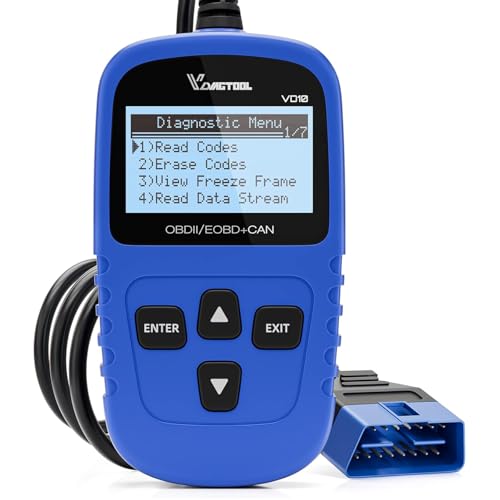
The VDIAGTOOL VD10 is pitched as a must-have for DIY enthusiasts, combining ease of use with practical capabilities. It attaches to the OBDII port for quick access to diagnostic data, offering read and clear functions, live data streams, freeze-frame capture, I/M readiness status, and vehicle information. The device provides a built-in database that translates generic, manufacturer-specific, and pending codes into definitions, helping users identify root causes and avoid online searches. It’s designed to be intuitive for beginners while still offering valuable data for hobbyists.
Key strengths include rapid code retrieval and clear on-screen definitions, along with coverage of all OBDII protocols. The VD10 aims to simplify the troubleshooting process by presenting actionable data in a single session, enabling faster repairs and better maintenance decisions without professional software or extra hardware.
MOTOPOWER MP69033 Car OBD2 Scanner

The MOTOPOWER MP69033 is a feature-rich OBD2 scanner built to work with all OBDII protocol cars since 1996. It offers a broad set of functions, including reading and erasing codes, viewing freeze frames, I/M readiness, and vehicle information. It also provides data flow, real-time curves, and calculated values such as engine speed and coolant temperature. The device is designed to be plug-and-play with a 2.8-inch LCD display for clear visibility and does not require batteries or a charger, drawing power directly from the car’s OBDII port.
With support for multiple languages and wide protocol compatibility, MP69033 caters to a diverse audience. Its practical interface and real-time data help users diagnose problems quickly, assess engine conditions, and verify repairs, making it a solid option for both home mechanics and on-the-go diagnostics.
ANCEL AD410 Enhanced OBD2 Scanner

The AD410 by ANCEL expands on basic OBDII functionality with enhanced diagnostics, including rapid reading and clearing of fault codes, troubleshooting for O2 sensors, EVAP systems, and comprehensive DTC lookup capabilities. It boasts extensive compatibility across 1996+ U.S., European, and Asian vehicles, making it suitable for households with multiple car types or for professional use. With multiple languages and direct power from the vehicle’s OBDII port, the AD410 provides a broad diagnostic scope without requiring external power sources.
Note that while it focuses on engine-level diagnostics and emissions-related codes, it does not support ABS, SRS, or other subsystem-specific functions. The tool’s strength lies in its fast data access, code interpretation, and EVAP/O2 testing features, which help users identify and address emissions-related issues and improve overall vehicle health.
OBD2 Scanner with Battery Tester — HipEpic

The HipEpic OBD2 Scanner combines traditional diagnostic capabilities with a built-in battery tester for a compact, all-in-one tool. It can read and clear engine fault codes, display real-time data streams, monitor I/M readiness, and provide vehicle information. A notable feature is the one-touch I/M readiness, which simplifies the process of checking whether the vehicle meets inspection standards. The device is plug-and-play with a 16-pin OBDII port and a user-friendly 2.8-inch color LCD, designed for both beginners and experienced users seeking rapid insights into engine health and electrical system status.
Its battery testing function adds an extra layer of maintenance value, helping users anticipate electrical issues that might affect performance or reliability. While ABS, SRS, and some advanced engine tests may be outside its scope, the HipEpic scanner covers a wide range of common diagnostic needs and delivers actionable data in a straightforward interface.
Buying Guide: Key Considerations for Choosing a Car Fault Code Reader
- Vehicle compatibility: Ensure the scanner supports your vehicle’s year, make, model, and OBD protocol. Most testers cover OBDII and CAN protocols, but some models may lack support for certain brands or advanced features.
- Code reading vs. code clearing: Some devices only read codes, while others can clear codes and reset the MIL. If you plan to repair issues yourself, a tool that can both read and clear codes is preferable.
- Live data and graphs: Real-time data, freeze-frame, and data plotting help diagnose intermittent problems. A larger, readable display improves usability in dim environments.
- Additional diagnostics: EVAP tests, O2 sensor tests, and I/M readiness checks are valuable for smog readiness and emissions troubleshooting. Identify which extras you need for your use case.
- Power source requirements: Most tools draw power from the OBDII port, eliminating the need for batteries. Some models include built-in testers or require external power for advanced features.
- Language support: If you prefer a particular language, check for multilingual capabilities to ensure Definitions are clear and easy to understand.
- Update access: Some scanners offer firmware or database updates via USB or Bluetooth. Consider whether ongoing updates are important for your maintenance needs.
- Budget vs. features: Entry-level scanners emphasize essential code reading, while mid-range options add live data, battery tests, and broader DTC databases. Match features to your expected use.
- Reliability and support: Look for reputable brands with responsive customer support and clear manuals or online guides to maximize value and ease of use.