Best Car Diagnostic Code Reader Guide to Quick Vehicle Fixes
Finding the right car diagnostic code reader helps you quickly identify why a check engine light is on, read live sensor data, and decide whether a visit to the shop is needed. This article reviews five reliable OBD II scanners suitable for American drivers, highlighting what each device does best, how easy they are to use, and what to consider when buying. The selections cover a range of budgets and capabilities so you can pick a model that matches your needs without guessing.
Buying at a glance: the table below summarizes the five highlighted products, emphasizing compatibility, core functions, and standout features. Use it to compare at a glance before diving into detailed sections.
| Product | Brand | Key Benefit | Connectivity | Live Data |
|---|---|---|---|---|
| ANCEL AD310 | ANCEL | Compact, fast codes read/clear | OBDII | Live data, freeze frame |
| VDIAGTOOL VD10 | VDIAGTOOL | Large code library, quick lookups | OBDII | Live data, I/M readiness |
| MOTOPOWER MP69033 | MOTOPOWER | Wide protocol support | OBDII | Real-time data |
| FOXWELL NT301 | FOXWELL | Professional-grade diagnostics | OBDII | Live data, VIN retrieval |
| Autel MS309 | Autel | Solid basic scanner with broad compatibility | OBDII | Emissions status |
ANCEL AD310 Classic Enhanced Universal OBD II Scanner

The AD310 from ANCEL is a compact, budget-friendly option designed for quick problem solving. It excels at reading and clearing emission-related trouble codes from 1996 and newer vehicles using OBD II protocols. The device provides fast, accurate results and supports viewing live data, freeze frame data, and memory storage. Its plug-and-play operation draws power from the vehicle’s OBD II port, so no external batteries are required. A durable 2.5-foot cable and clearly labeled buttons help technicians and DIYers work efficiently in confined engine bays.
Features emphasize ease of use and practical reliability. Users can rapidly identify the check engine light cause, then clear the codes after repairs. The AD310 handles both reading and clearing codes, plus basic live data interpretation, so you can confirm the fix has resolved the issue. Its compact form factor is ideal for tool kits and on-road use, reducing the chance of dropping the device during roadside diagnostics.
In terms of limitations, the AD310 focuses on standard OBD II functions and does not include advanced bi-directional controls or extensive component testing found in higher-end scanners. It is best suited for routine maintenance checks, basic fault code retrieval, and quick repair verification rather than in-depth system-wide diagnostics. Overall, it’s a dependable starter scanner for homeowners and hobbyist mechanics who want a simple, fast solution.
VDIAGTOOL VD10 OBD2 Scanner
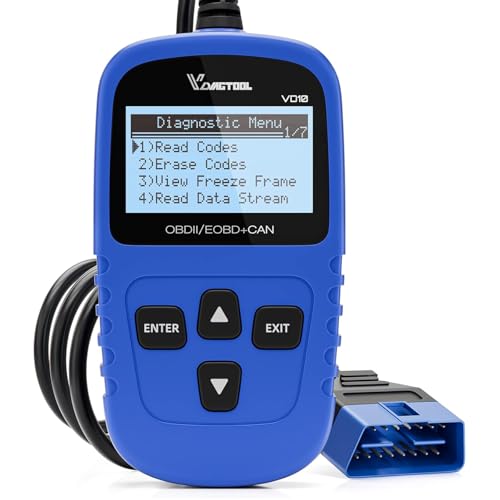
The VD10 is positioned as a value-oriented tool for DIYers and casual car owners. With a straightforward setup, you attach it to the OBD II port and begin diagnosing within seconds. It reads and clears codes, displays DTC definitions, and supports I/M readiness checks and live data views. The built-in database is designed to speed up diagnosis by providing instant code interpretations, reducing the need for external searches.
VDIAGTOOL emphasizes accessibility and user-friendliness. The device retrieves generic and manufacturer-specific codes and provides a robust code dictionary on the screen to help users identify the root cause quickly. It also offers live data streams to monitor sensor behavior in real time, which can be useful when diagnosing intermittent issues or verifying repairs after work is completed.
As a practical, budget-friendly tool, the VD10 is best for basic code reading, clearing codes, and checking readiness status. It does not offer the depth of professional-grade scanners in terms of advanced bi-directional controls or in-depth component testing, but its quick setup and comprehensive DTC library make it a strong choice for homeowners and hobbyists focusing on routine maintenance and repair verification.
MOTOPOWER MP69033 Car OBD2 Scanner

The MP69033 from MOTOPOWER focuses on broad protocol support, covering most 1996 US-based, 2000 EU-based, and Asian vehicles, plus newer OBD II and CAN vehicles. Its feature set includes reading and erasing codes, viewing freeze frame data, I/M readiness, and providing vehicle information. A notable benefit is its 2.8-inch LCD with backlighting for easy viewing in dim conditions, which is useful in garages or shaded parking areas.
Power for the MP69033 comes directly from the vehicle via the OBD II port, eliminating the need for external batteries or chargers. The device offers a practical balance of performance and simplicity, enabling quick code retrieval and straightforward diagnostics suitable for DIY diagnostics and routine upkeep. While it provides essential functionality effectively, it remains focused on core OBD II features rather than specialized or manufacturer-specific diagnostics.
For users who want broad compatibility across many vehicle makes and models without a steep learning curve, the MP69033 is a strong candidate. It’s particularly appealing to owners who frequently work on different car brands and need a single scanner that covers most standard OBD II vehicles.
FOXWELL NT301 OBD2 Scanner

The NT301 from FOXWELL is positioned as a professional-grade tool suitable for mechanics and serious DIYers. It provides access to vehicle fault codes, emissions readiness status, and the ability to reset the MIL. A key feature is its live data streaming and the option to retrieve the vehicle VIN, which helps verify compatibility and document vehicle specifics during service. The NT301 is designed to read and display diagnostic data in a user-friendly interface, making it a practical choice for many diagnostic scenarios.
However, the NT301 has limitations typical of entry-to-mid-level professional scanners. It does not support all advanced systems like ABS, SRS, or transmission-specific diagnostics in every case, and it cannot clear codes until repairs are completed. This behavior is common among many scanners that avoid offering full system resets until underlying issues are addressed. For those who want reliable code reading, live data, and VIN retrieval, the NT301 offers a solid balance of capability and price.
ANCEL AD410 Enhanced OBD2 Scanner

The AD410 from ANCEL is a step up in diagnostics, offering wide compatibility across 16-pin OBD II vehicles and enhanced features like testing of O2 sensors and EVAP systems. It supports quick reads and clears of stored and pending codes, along with monitoring readiness and EVAP status. While it emphasizes broader diagnostic capabilities, it remains focused on engine health rather than full-system bi-directional control, which makes it suitable for users who want more than a basic code reader but do not require complex service functions.
Note that the AD410 is still essentially an engine-centric tool and cannot perform advanced resets on ABS, SRS, or other subsystems. It’s ideal for checking emissions-related faults and getting a deeper sense of the engine management state without stepping into the territory of high-end professional scanners. The device’s design, built-in DTC lookup, and EVAP testing capacity position it as a versatile option for home garages and automotive hobbyists seeking more diagnostic insight than entry models provide.
Buying Guide: Choosing The Right Car Diagnostic Code Reader
- Vehicle compatibility: Confirm that the scanner is compatible with your vehicle’s year, make, and model. Look for OBD II support as a baseline for most 1996+ cars in the US, with specific notes for vehicles using SGW or FCA AutoAuth security systems.
- Core functions: Decide which features you need—reading/clearing codes, live data, I/M readiness, VIN retrieval, freeze frame data, and DTC definitions. If you regularly work on multiple cars, a device with a robust DTC library and live data capabilities is valuable.
- Ease of use: For DIY users, a straightforward interface and clear on-screen definitions help reduce troubleshooting time. A readable display and a compact form factor can be decisive for on-the-go diagnostics.
- Depth of diagnostics: Higher-end scanners provide more features like bi-directional controls, advanced parameter testing, and multi-system diagnostics. Consider whether you need only engine codes or broader access to ABS, SRS, or transmissions.
- Power source: Most OBD II scanners draw power from the vehicle; some require batteries or chargers for certain functions. Ensure the device suits your typical use case (garage vs. roadside).
- Linguistic support: If you prefer non-English interfaces, multilingual support can reduce learning time and improve clarity of codes and definitions.
- Price vs. value: Balance the cost against the number of vehicles you service and the depth of diagnostics you require. Budget models excel for basic needs, while mid-range options suit regular maintenance on multiple cars.
- Manufacturer reliability: Devices from established brands with broad community support and reviews tend to offer more consistent software updates and better customer service.
- Updates and app support: Some models pair with companion apps for repair guidance and ongoing code interpretation. Check whether updates are free or require a subscription.
- Warranty and support: A longer warranty and accessible support are practical advantages, especially for tools used in a professional or semi-professional setting.
Choosing the right car diagnostic code reader involves weighing how often you diagnose issues, how many vehicles you service, and how deep your diagnostics go. The models reviewed balance reliability, ease of use, and value, offering options for homeowners who want quick insights and hobbyists who want a broader diagnostic toolkit. By aligning features with your typical vehicle profile, you can select a reader that helps you identify problems sooner and verify fixes more confidently.