Best Air and Fuel Gauge for Real-Time Engine Tuning
The right air/fuel ratio gauge helps you monitor engine performance, detect rich or lean conditions, and protect your motor during tuning. This article highlights five widely compatible wideband air/fuel gauges, their standout features, and how to choose the best option for your vehicle. All selections emphasize fast response, accuracy, and easy installation across 2-1/16″ (52mm) gauge housings.
| Product | Brand | Key Benefit |
|---|---|---|
| Wideband UEGO Air/Fuel Ratio Gauge 52mm | FHRHRY | Fast 0-5V output with color-changing LED display |
| 30-0300 Wideband UGEO AFR Gauge Kit | Gledewen | Dual-calibration options and 24-color display |
| AEM (30-4110) UEGO AFR Gauge | AEM | No free-air calibration; robust 4.9 LSU sensor |
| GlowShift Black 7 Color Digital AFR Gauge Kit | GlowShift | Multi-color display with data logging output |
| ZHSYMX Universal Digital Wideband AFR Gauge | ZHSYMX | Wide compatibility with data loggers and ECU systems |
Choosing the right gauge depends on sensor quality, calibration options, display versatility, and installation flexibility. The following sections review each option’s core strengths and how they fit into common tuning scenarios, from street setups to race applications.
Wideband UEGO AFR Gauge With Easy Color Choice
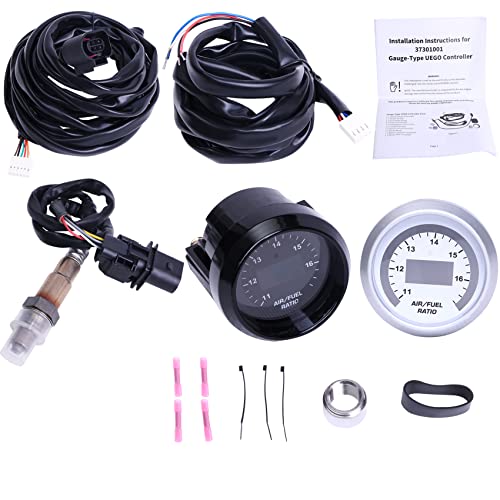
The Wideband UEGO Air/Fuel Ratio Gauge from FHRHRY features a digital LED display with a color-changing needle that shifts as AFR varies from rich to lean. Its 52 mm housing fits most instrument pods, and the 0-5V analog output supports data loggers and most engine management systems. The included 4.9 LSU sensor delivers fast, precise readings, helping you respond quickly to AFR changes between 0.1 increments and ensuring engine safety during tuning. The gauge offers multiple bezels and faceplates for easy customization.
Gledewen 52mm Wideband AFR Gauge With Four-Calibration Modes

Gledewen’s AFR gauge focuses on flexibility and quick diagnostics. It features a sweeping 24-color LED display with a four-digit central readout and supports display modes for AFR, lambda, and oxygen percentage. The kit is matched to LSU4.9 UEGO sensors for fast response (around 20 ms) and accurate real-time reporting. It offers two calibration modes—rCAL (resistor trim) and ACAL (free air)—giving users options for precision without extensive field adjustments. The kit’s 52 mm housing is compatible with many instrument pods for remote mounting.
AEM UEGO AFR Gauge With No Calibration Needed

The AEM UEGO AFR Gauge (model 30-4110) includes a Bosch 4.9 LSU wideband sensor and a weld-in bung. The package emphasizes user-friendly setup with no required free-air calibration, and it comes with interchangeable black and white faceplates to customize the gauge appearance. The 2-1/16″ housing fits standard gauge pods and supports remote mounting. This gauge is well-suited for engine tuning where consistent AFR tracking and seamless integration with ECU data loggers are priorities.
GlowShift Black 7 Color AFR Gauge Kit

GlowShift’s Black 7 Color Series offers a multi-color digital display with a 2-1/16″ gauge. It ranges from 10.00 to 20.00 AFR for standard gasoline and extends to 6.00–12.00 AFR for E85, providing flexibility for different fuel blends. The kit includes an oxygen sensor, data logging output, a weld-in bung, and wiring. With seven solid color modes and two color cycle options, it’s designed to visually integrate with diverse dashboards and lighting schemes while delivering reliable AFR readings.
ZHSYMX Universal Digital Wideband AFR Gauge

The ZHSYMX Universal Digital Wideband AFR Gauge provides real-time feedback with high accuracy and fast response. Its digital wideband technology enables straightforward reading and reliable reporting to engine management systems or data loggers. The 52 mm housing ensures easy installation in standard gauge pods and broad system compatibility, including vehicle voltages up to 16V. This gauge is suitable for users seeking universal compatibility across various ECM platforms and logging tools without sacrificing speed or precision.
Buying Guide
- Sensor quality and calibration: Look for a 4.9 LSU wideband sensor for fast, precise readings. Some kits offer dual calibration modes or no calibration requirements, which can simplify setup.
- Display and user interface: Choose a gauge with a clear LED or digital display and a color-coded or multi-mode readout (AFR, Lambda, O2%). Ensure the faceplates are easy to read at a glance, especially in low light.
- Output compatibility: 0-5V analog outputs facilitate logging and ECU integration. Confirm compatibility with your data logger or engine management system by model or sensor type.
- Physical fit and installation: Most 2-1/16″ (52 mm) gauges fit standard instrument pods. Consider remote mounting possibilities and whether you need interchangeable faceplates for aesthetics.
- Calibration options: Some gauges offer rCAL (resistor trim) or ACAL (free air) calibration. Evaluate whether you prefer a guided calibration path or built-in defaults.
- Extendability and data logging: If logging is important, verify whether the kit includes data outputs or interfaces for your preferred software.
- Fuel compatibility: Some gauges specify AFR ranges for gasoline, E85, or other fuels. Ensure the chosen gauge supports your fuel type and expected AFR window.
- Installation environment: For harsh or high-vibration installations, select gauges with robust housings and secure mounting options to maintain measurement accuracy over time.
In market comparisons, considerations such as calibration ease, display versatility, and ECU compatibility typically drive final choices. For street tuning, a gauge with clear color cues and simple installation is often preferred. For racing or more aggressive tuning, prioritize fast response, wide AFR measurement range, and strong data logging support to track performance across multiple runs.