Best 4 Barrel Carburetor Options for 302 and Other V8 Engines
When upgrading or restoring a classic V8, a reliable 4-barrel carburetor is essential for good throttle response, power delivery, and drivability. This guide highlights five well-regarded options that fit a range of American V8s, including engines around the Chevrolet 302 displacement. Each pick emphasizes compatibility, durability, and ease of installation, helping you choose a carburetor that meets performance goals without requiring extensive tuning. The selections cover square-bore designs, electric or manual chokes, and mechanical secondaries to suit street, weekend, and racing needs.
Summary of chosen products:
| Product | Brand | Key Feature |
|---|---|---|
| QBselecar 4 Barrel Square Carburetor | QBselecar | Electric choke, wide compatibility |
| BR-67201 850CFM 4-Barrel Carburetor | Generic | 4150 double pumper, mechanical secondary |
| 1406 Carburetor for Performer 600 CFM | Condgreemee | AFB-style, square bore, two-step metering |
| Soklopi 4 Barrel Carburetor | Soklopi | Manual choke, 1960s-era combos |
| BR-67255 for Holley Quick Fuel Brawler | Voyagrise | 650 CFM, electric choke, dual inlet |
QBselecar 4 Barrel Square Carburetor

Designed as a replacement for common 1406-600 CFM designs, this square-bore carburetor fits a broad roster of GM and Ford platforms. It lists compatibility with Chevy Chevelle, Corvette, Silverado, Camaro, and Ford variants like Mustang and Bronco, among others. The unit is built from heavy-duty zinc alloy for improved hardness and corrosion resistance, aiming at longevity and steady performance under varied conditions. It’s a direct replacement option for several Performer-series carburetors, with care taken to note it’s not suitable for computer-controlled applications.
BR-67201 850CFM 4-Barrel Carburetor

This 850 CFM 4-barrel carburetor uses a 4150 double-pumper design with square bore and annular boosters for high-performance applications. It’s a direct replacement intended for Holley Quick Fuel Brawler 850CFM BR-67201 models and is machined for a precise fit with no modifications. Dual fuel inlets and mechanical secondary throttle plates improve fuel delivery and throttle response under demanding conditions, making it suitable for street and race settings where robust power is needed.
1406 Carburetor for Performer 600 CFM

This 4-barrel square-bore carburetor is designed as a direct replacement for a 600 CFM Performer series. It features two-step metering rods to aid transitions between circuits, reducing backfiring and enabling smoother acceleration. The primary venturi booster is bottom-feed for improved drivability, and it’s compatible with a wide range of manifolds including Performer and RPM-series. It’s not intended for computer-controlled engines, and it’s suitable for Chevrolet, GM, and GMC trucks, as well as Ford setups where a 600 CFM is appropriate.
BR-67255 4 Barrel Carburetor For Holley Quick Fuel

This 650 CFM replacement is designed for Holley Quick Fuel Brawler carburetors with a 4150 square bore flange. It features electric choke and dual inlet fuel bowls with sight glass windows for easy float adjustments. The kit aligns with BR-67255, offering a robust option for those seeking reliable mechanical secondary operation with an electric choke for consistent cold starts. It emphasizes durability and precision, suitable for racing or performance street use where a 650 CFM rating is appropriate.
Edelbrock 1405 Performer 600 CFM

The Edelbrock 1405 is a classic 600 CFM square-bore carburetor designed for marine and automotive applications alike. It features a single feed fuel inlet, air valve secondary configuration, and a shiny silver finish calibrated for gasoline. While primarily tuned for marine contexts, its dependable design and manufacturer support make it a viable option for street machines seeking reliable baseline performance with straightforward maintenance.
SJDYYMX 1405 600 CFM Manual Choke
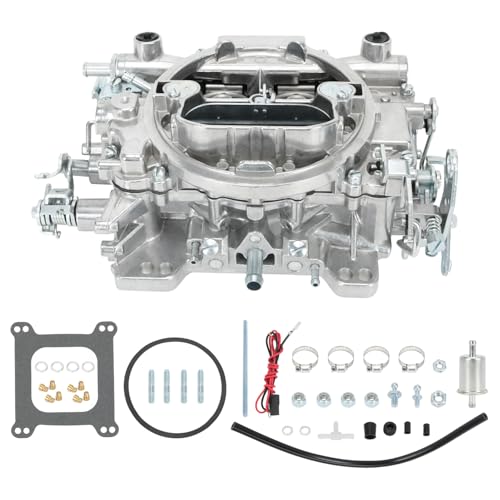
This 1405-style 600 CFM four-barrel is designed with a manual choke and square bore flange, making it compatible with a variety of GM-based manifolds, including Performer EPS and RPM Air-Gap. It is not suited for computer-controlled engines. The package commonly includes basic installation parts, and it targets users who want a straightforward, non-electronic choke upgrade with dependable cold-start and drivability characteristics for Chevrolet, GMC, and Corvette platforms.
Buying Guide: 4 Barrel Carburetor Considerations
- Engine compatibility: Confirm flange pattern (usually square bore), CFM rating, and choke type (electric vs manual) match your engine and intake manifold. For small-block V8s like the Chevy 302, 600–850 CFM is a common range depending on displacement, cam, and exhaust setup.
- Throttle action and secondaries: Mechanical secondaries deliver more aggressive throttle feel, while electronic or vacuum secondary designs prioritize smoothness and fuel efficiency. Choose based on driving style and intended use (street vs. performance).
- Choke type and cold starts: Electric chokes simplify cold starts, while manual chokes require driver interaction. Consider climate and maintenance expectations when selecting.
- Material and durability: Carburetors constructed from robust alloys resist corrosion and wear, extending service life in varied weather conditions. Look for zinc or aluminum housings and quality gaskets.
- Installation and compatibility: Some carburetors are labeled as direct replacements for specific models; others require adapter plates or manifold matching. Review manifold compatibility and any accessory fitment before purchasing.
- Tuning and maintenance: Note whether the carburetor comes with metering rods, jets, or kit components. Availability of replacement parts and tuning support varies by brand.
- Intended use: For performance builds, prioritize models with mechanical secondaries and higher CFM ratings. For daily drivers, prioritize reliability, emissions considerations, and ease of tuning.