Best Car Charging System Tester for Battery and Alternator Diagnostics
The right car charging system tester helps you quickly assess battery health, cranking power, and charging performance across 12V and 24V systems. This guide reviews five top-rated models, highlighting how each handles SOH, SOC, voltage, cranking, and charging tests. Use the comparison to pick a tool that fits your garage or small shop needs.
| Product | Brand | Core Capabilities | Voltage Range |
|---|---|---|---|
| TOPDON BT100 Car Battery Tester | TOPDON | SOH, SOC, voltage, current, CCA; 3 testing modes | 12V |
| MOTOPOWER MP0515A 12V Car Battery Tester | MOTOPOWER | Battery health, charging status, alternator output; 12V | 12V |
| ANCEL BA101 Car Battery Tester | ANCEL | SOH, SOC, voltage, CCA; cranking and charging tests | 12V |
| Acclope BT60 PRO Car Battery Tester | Acclope | SOH, SOC, CCA; 6V/12V/24V support;LiFePO4 checks | 6V/12V/24V |
| KONNWEI KW208 12V Car Battery Tester | KONNWEI | Voltage, internal resistance, CCA, health status; quick tests | 12V |
TOPDON BT100 Car Battery Tester

The TOPDON BT100 is a 12V battery load tester designed to assess common lead-acid batteries used in cars, trucks, motorcycles, and larger vehicles. It provides State of Health (SOH), State of Charge (SOC), voltage, current, and rating data, helping users gauge overall health and remaining capacity. The device supports 100-2000 CCA batteries and handles flooded, AGM, EFB, and GEL chemistries for practical compatibility. Its passive testing method reduces the risk of device power drain, enabling safe, on-vehicle testing across multiple vehicle types. The BT100 includes a three-test function suite: battery health, cranking power, and charging system verification, aiming to prevent roadside failures and ensure reliable start-ups before long trips.
MOTOPOWER MP0515A 12V Car Battery Tester

The MOTOPOWER MP0515A offers a modern interface and quick readouts for 12V batteries from 100 to 2000 CCA. It focuses on battery health, charging status, and alternator output, enabling swift decisions about jumps or replacements. The tester applies a contemporary algorithm to classify results into health categories and reports internal resistance and test conclusions (mediocre, good, excellent). It supports a broad range of 12V lead-acid chemistries, making it a practical choice for DIYers and professional garages seeking fast, clear results without extensive setup.
ANCEL BA101 Car Battery Tester

The ANCEL BA101 emphasizes broad accessibility and reliability. It delivers SOH, SOC, voltage, current, and CCA readings, along with cranking and charging system tests. The unit’s design uses copper crocodile clips and smart-chip engineering to improve reading stability and repeatability. Accuracy is enhanced when the user inputs the correct battery type, rating, and temperature as shown on the label, ensuring a clearer picture of the battery’s real condition. The BA101 provides fast, readable results on its classic display and supports multiple languages for diverse users.
Acclope BT60 PRO Car Battery Tester
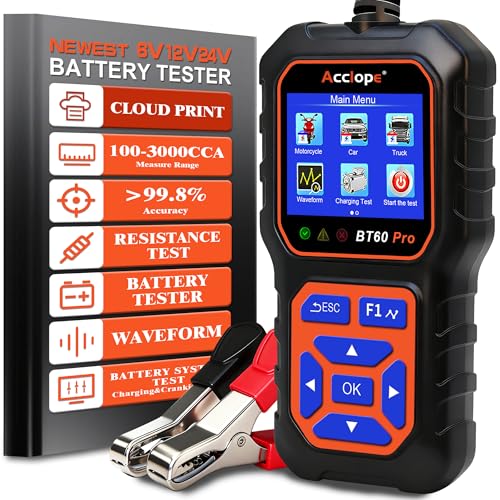
The Acclope BT60 PRO supports 6V, 12V, and 24V batteries, including lead-acid, AGM, GEL, EFB, and select lithium chemistries for voltage and health checks. It provides comprehensive diagnostics on SOH, SOC, resistance, and CCA, with fast performance thanks to a high-precision chip and advanced conductance algorithms. While strong in general diagnostics, lithium CCA results may not be guaranteed. The BT60 PRO is positioned for professionals and DIY users who need quick, repeatable tests across a range of vehicle types, including motorcycles and trucks, with clear results and reliable data interpretation.
KONNWEI KW208 12V Car Battery Tester

The KONNWEI KW208 is marketed as a cost-effective, all-in-one 12V battery load tester with 100-2000 CCA support. It provides voltage, internal resistance, CCA, and health/charge status, delivering a quick overall view of battery condition. Its updated galvanized alloy clips improve durability and contact reliability, while the device’s AI-assisted measurements emphasize speed and accuracy. The KW208 is popular for glove-box storage and light-duty professional use, offering dependable readings with straightforward interpretation for quick maintenance decisions.
Buying Guide
Key purchase considerations help compare car battery testers beyond raw features:
- Voltage and battery type support: Most testers cover 12V systems, with some also supporting 24V and LiFePO4 chemistry checks. Decide which voltages and chemistries you need for your fleet.
- Test range and accuracy: Look for devices that measure SOH, SOC, voltage, current/CCA, and provide cranking and charging diagnostics. Higher accuracy reduces false positives or missed faults.
- Ease of use: A clear display, fast test results, and intuitive prompts save time in busy garages. One-handed operation and long test leads can improve workflow.
- Durability and safety: Rugged housings, quality clips, and safe passive testing help protect both the device and the vehicle’s electrical system.
- Data interpretation: Some models offer simple “GOOD/REPLACE/CHARGE” outputs or color-coded results, while others provide detailed analytics. Consider your needs for either quick checks or in-depth diagnostics.
- Portability and storage: Compact units with protective cases are ideal for garages with limited space or for field use.
- Customer support and compatibility: Brands with strong user communities and clear documentation can aid troubleshooting and learning, especially for new technicians.
Choosing between models often comes down to desired balance of features and budget. For basic vehicle health checks and general maintenance, a mid-range tester with solid SOH/SOC readings and a reliable cranking test is usually sufficient. For professional shops or fleet maintenance, prioritize higher accuracy, broader voltage compatibility (including 24V), robust build quality, and advanced diagnostics to minimize diagnostic guesswork.